How to Grow a Third Arm

Standard

How much more productive would you be with a third arm? I have a formula for one! Fear not, it doesn’t involve psychedelic mushrooms and vodka (a disappointment for some). It involves tactful trust and developmental delegation.

This could be you! Well, sorta.

This could be you! Well, sorta.

Investing in others is a scary thing, especially when you are trusting them to handle something precious to you. But think about making your life and job EASIER and all of the benefits that come with MORE TIME. Before you can develop anyone you need to develop yourself. Start thinking positively about the benefits of teaching someone to do the more basic tasks within your scope of responsibility.

Simply put, attempt to categorize all tasks into two columns: “No Mistakes Allowed” & “Mistakes Tolerated.” The first column must stay within your direct control as we cannot afford a problem there. The second column is where we start considering which tasks could be shared as a learning experience with an emerging talent. Maybe it’s 1 task, possibly 3? Choose a total that offers a meaningful return on your investment in terms of time. Identify the skill needed for the task and then seek out your third arm.

  • Manage Payroll – Detail Oriented, Accounting Skills, Time Management
  • Organize Meetings  – Communicator, Collaborative Personality, Tech Savvy
  • Attend Meetings for You – Professional, Listener, Understands Inter-Office Politics
  • Project Management – All of the above!

Scan your roster of dedicated teammates and find the match between skill and ability. The most important step in this process is to directly ask your targeted teammate if they are eager to “learn more about the environment” or “learn more about the next level of management?” It’s critical to capture the right attitude, and this starts with an up front commitment between both of you to teach and learn with the proper spirit. Even when you find the right attitude you still might not know if you’ve matched the right person to the right task, but this is part of the cost to growing extra extremities. You WILL MAKE MISTAKES, as will the teammate you choose. But that’s OK! You gave them tasks that can be corrected if mismanaged. When mistakes are made, you will flip the “Teacher” switch and live up to your end of the bargain (developing your talented third arm).
51278255

Let’s review the benefits of pushing through this initial investment of time to delegate and develop. You are rewarding an eager teammate with the chance to enhance their contribution to an environment they care about. The reward of mentorship is gratifying, appreciated, and has no hard cost. These efforts are often public and the entire team sees your efforts to reward talent with attention, a leader’s greatest currency. Finally, look at all the time you stand to gain (or invest elsewhere)? Let’s assume that managing payroll takes 3 hours a month, organizing meetings takes 2 hours a month, attending meetings in your place takes 8 hours a month, and managing projects takes 10 hours a month. You stand to get 3 to 23 hours a month to reposition within your job scope.

What would you do with 23 freed up hours given your current workload? What would you do with your third arm? How about a “High-15?” Slap-Slap-Slap!

NBA Financial Player of the Year: David Stern

Standard

Once in a while someone will introduce an intriguing sports debate: Who is the best commissioner of North American professional sports? Although former NBA commissioner David Stern has retired, I think he’s at least the NBA’s “Financial Player of the Year.”

The fact most often neglected when these debates unfold is the concept placing each league’s commissioners as employees working for the various groups of owners. Their job? Make sure things run smoothly and increase shareholder wealth. Fans usually neglect the aforementioned methods of measurement. Instead, we are naturally forced to focus on the decisions made on the surface (instant replay implementation, rules changes, equipment modifications, enforcing policies). After all, it’s difficult for fans to assess a commissioner’s financial impact on privately held firms spread out amongst very different markets.

The headline of the month seems to be the reported sale of the L.A. Clippers for $2 billion. This is an incredible outcome from the Donald Sterling scandal, which forced the new NBA commissioner, Adam Silver, and the existing NBA owners to enforce the expulsion of an owner and sale of his franchise. League members and fans will benefit from the exclusion of a man who is a complete cultural mismatch with the brand. Others will point to the bittersweet reality that Donald Sterling will rake in an incredible profit.

Although the league’s franchises are privately held firms, we get a glimpse of the numbers when a sale is made. To illustrate why I am applauding David Stern’s financial acumen, take a look at this timeline:

  • 2006 – Seattle Supersonics sold for $350 million
  • 2010 – NBA buys New Orleans Hornets for $300 million
  • 2012 – Memphis Grizzlies sold for $350 million
  • 2012 – NBA sells New Orleans Hornets for $338 million
  • 2014 – Milwaukee Bucks sold for $550 million
  • 2014 – L.A. Clippers receive bid to purchase for $2 BILLION

If you look at the NBA map you’ll notice that these transactions are happening all over the U.S. and the spread between them is tens and hundreds of millions of dollars. What you won’t see is how David Stern leveraged every available financial resource to react to a fluctuating economy. He made a variety of decisions to preserve franchise values and avoid market corrections on the hedge that the domestic economy would recover. What were those moves?

Starting in 2006, the Seattle Supersonics sale established general market pricing ($350 million). The New Orleans Hornets’ owner went broke in 2010 and couldn’t afford to maintain his business. He tried to sell, but no one was able to meet his price. The risk of settling for a number too far south of the Sonics’ $350 million sales price was a reality that Stern avoided. Stern convinced the NBA to buy the Hornets for $300 million. He also secured $200 million of additional credit for a league accessible emergency fund for all franchises to use. The NBA held onto the Hornets and waited out the most severe economic rain clouds. Two years later, the NBA sells the Hornets for $338 million, including $50 million in commitments from New Orleans to update their home arena ($383 million of ownership “value”). And then we see consecutive sales records occur just two years later, one of which is achieved in a smaller market (Milwaukee)!

This trajectory in NBA franchise sales prices is not an accident. It’s the result of a combination of factors, both economic and strategic. Here’s a fun question. What would have happened if Stern let the market dictate pricing for the Hornets sale in 2010? What if the best Hornets’ offer was $200 million?

It is with great honor I present this year’s NBA “Financial Player of the Year”, David Stern.

Free Miracles! No Money Required!

Standard

philanthropy

Living in one of the most blessed and wealthy countries on the globe comes with a lot of “pros” and a few “cons.” One con of being submerged in a capitalist society is the jaded sense of what the modern definition of a “miracle” is.

Some of the most popular television shows of the past 5 years have revolved around miracles that are simply lump sums of money gifted to people in need, typically from a wealthy business or business person. “Undercover Boss” and “Extreme Home Makeover” are a few of the better-known examples of this. When my wife watches these shows, she wells up with tears when a check swoops in to wash away someone’s troubles. I respect the generosity of philanthropists, and I acknowledge that I have personally benefitted from such giving. I am not attacking the concept of philanthropy.

I fear that Americans watch these shows and think, “Someday, I hope to be wealthy enough to help someone with a big check.” The truth is that miracles can happen every day, without large checks. There are meaningful ways within the world of business, and within our personal lives to make a miracle happen. Don’t underestimate the small miracles that mean so much more to their potential recipients.

If you are reading this you are probably wealthy with thoughtfulness, courage, and talent! This means you are already capable of making a miracle happen. Are you an expert in an industry or a successful businessperson? You could mentor a young professional who lacks some of the gifts you possess. Have you heard a rumor about a co-worker and thought to treat it as fact? Ignore it, and give that person a chance to invalidate those stories. You never know what emotional or intellectual need you could appropriately and generously fulfill for someone unless you have your ears and eyes open, instead of your checkbook.

I challenge you to look for those “Free Miracles” that actually cost the most precious commodity we have: TIME. Take a little time to create a miracle for someone and YOU will feel wealthy beyond the shallowness of currency. I guarantee it!

Need to Enhance Team Communication? Visit an “Alarm Room!”

Standard
No smartphones? Didn't matter. The team that used this room were elite communicators

No smartphones? Didn’t matter. The team that used this room were elite communicators.

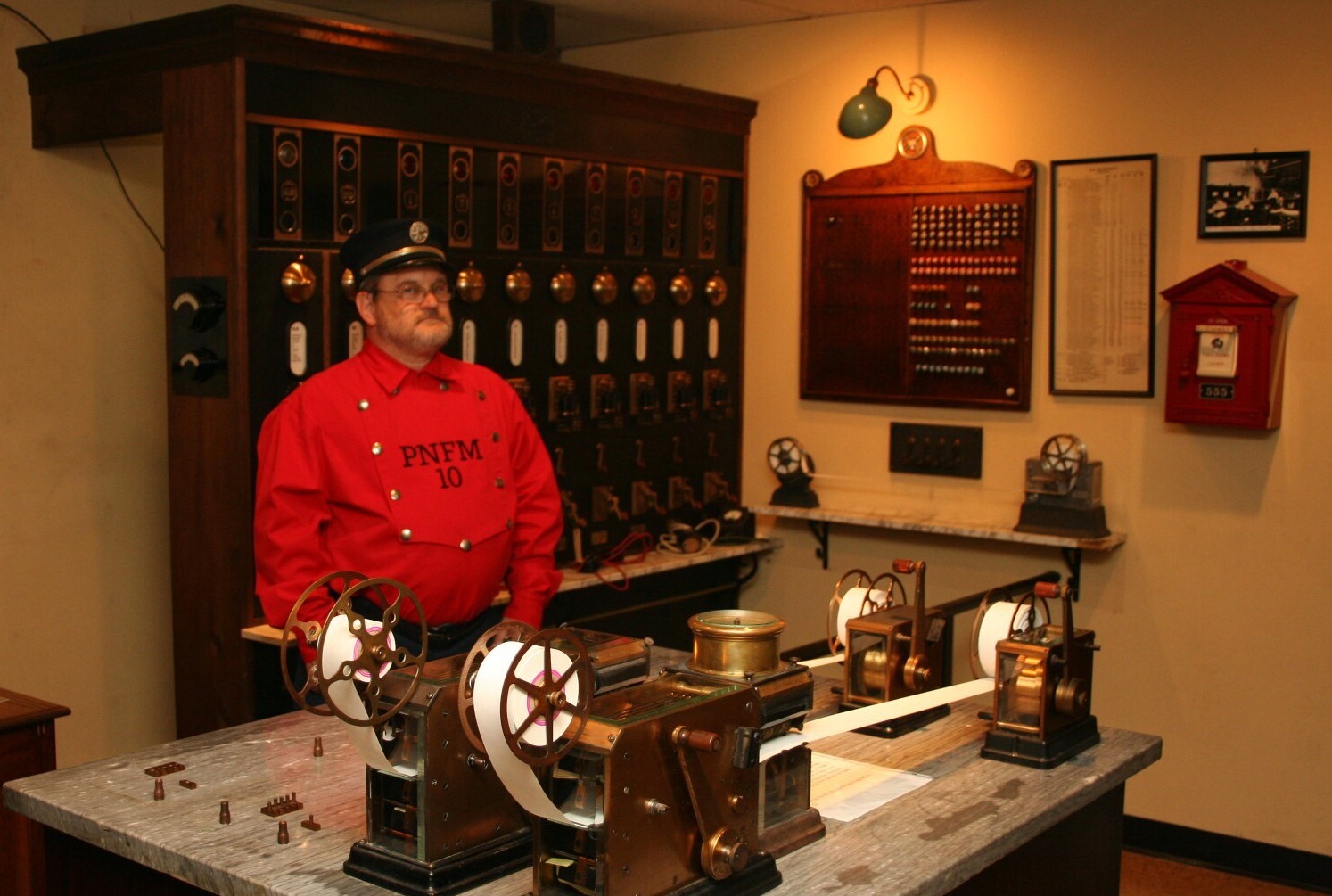
If you manage a team or lead a department that is struggling with communication, it might be time to visit one of the most unique and inexpensive examples of functional communication. The Fire Museum of Maryland is tucked just north of downtown Towson, hidden behind a few ambiguous buildings on York Road. I visited the museum one random weekend to support a friend and while there I was given a tour of something I never knew existed. It’s called the “Alarm Room.”

The Alarm Room first strikes you as something from “Chitty Chitty Bang Bang” or “Willy Wonka and the Chocolate Factory”, but it is the brain child of late-1800’s firefighters leveraging creative and limited communication technology. It is whimsical and humbling to see in action. Here is the process (knowledgeable historians, please forgive my casual descriptions):

  • A fire is spotted and someone pulls a fire-box alarm on the street. The box sends a signal through wires to the main firehouse dispatcher, communicating the threat of a fire.
  • A receiver within the dispatch center sounds a bell alarm, and ticker tape messages start to flow from a reel of tape connected to a hole punching morse code type device.
  • The ticker tape morse code device taps out a fortune cookie-wide stream of punched holes, and the dispatcher translates the location of the alarm box near the fire.
  • Dispatch then sounds the alarm from a church organ sized motherboard that looks like a wall of lights, knobs and levers. Signals are sent from the this board to the fire house nearest or most available to the fire.
  • The firefighting resources are dispatched, and when they get there they head to the box alarm and begin tapping out more morse code communication to the dispatch center to confirm their arrival and/or need for more resources.
  • The dispatch center measures who is where with a peg board method, as well as how long each resource is allocated. More ticker tape, buzzing bells, blinking lights, and we (anyone operating the Alarm Room) aren’t even at the scene of the fire! Once the fire is dealt with, the alarm box is turned off and the confirmation is sent.

The Alarm Room had everything but two coffee cans strung together, but it saved lives for decades! Seeing its primitive, clanking, and mechanized process gently unfold while chaos ensued at the scene of a fire distracted me from all of the limitations firefighters faced. The physical distance between a dispatcher and a firehouse could be significant, sometimes miles away with no other channel of communication. The time it took for each message to be tapped out, decoded, and then responded to could have taken minutes to develop. Resources were limited and needed to be managed. Compared to the way things work today, you can’t help but ask how this was so successful?

stringandcans

This is about EFFORT. Teams and departments that struggle with communication might shift blame towards a variety of modern-day excuses. Not enough time available to communicate? You can’t get in front of someone because he/she is hard to track down? You claim that you don’t have enough resources or the right tools to communicate? Shame on you! Technology is the answer and most businesses have plenty of it. So what is the real reason?

How was the Alarm Room process consistently effective? Experiential learning delivers the concept dynamically. If you can visit the Alarm Room with your management peers and teammates, seeing it in action will convey what my blog cannot. No matter how restricted you and your team may be, if everyone sits down to build a thoughtful communications program collaboratively by combining creativity and the available tools, that process will be effective regardless of the presence of smartphones and cutting edge technology. I encourage you to visit the Fire Museum of Maryland to see it yourself. The experience of seeing it first hand is inspiring.